World Cancer Day is a global event which takes place annually on 4 February to educate and raise awareness about the disease with the aim of saving millions of preventable deaths each year. This year’s theme ‘We can. I can’ explores how everyone can do their part to reduce the global burden of cancer.
Joan Benach, Alejandra Vives, Gemma Tarafa, Carlos Delclós and Carles Muntaner
João was 14 when he got his first job at a Brazilian bank. By the time he was 19, he was working part-time as an assistant to the board of directors of a multinational bank while working on a technical degree in foreign trade. He was earning about US$150 a month when he applied for a full-time position in the trade sector, but his application was denied because he was seen as too valuable in the position he held at the time. He then began to work on getting a university degree, but monthly payments cost more than what he was earning per month. When he saw his next transfer application for a different position in the trade sector denied, he left the university and decided to move to Canada. He felt that learning English would be a good way to improve his employment prospects.
Once there, he realised everything was more expensive than he had originally anticipated. Despite having only a tourist visa, João got a series of short-term jobs to support his English training. He worked brief stints as a carpet installer, an office assistant and, finally, as a bricklayer. It was in this final position that he earned CDN$29 an hour, over three times more than the minimum wage he’d earned in his previous jobs. Yet, as an undocumented worker, he was denied political, health and educational rights, and was constantly exposed to abuse by his employers and severe income insecurity. Moreover, the overlong work shifts, the exhausting nature of his tasks and a constant exposure to toxins took a substantial toll on his body.
Since their introduction in the United States in the 1940s, artificial fluoridation programmes have been credited with reducing tooth decay, particularly in deprived areas. They are acknowledged by the US Centers for Disease Control and Prevention as one of the ten great public health achievements of the 20th century (alongside vaccination and the recognition of tobacco use as a health hazard). Such plaudits however, have only gone on to fuel what is an extremely polarised ‘water fight’. Those opposed to artificial fluoridation continue to claim it causes a range of health conditions and diseases such as reduced IQ in children, reduced thyroid function, and increased risk of bone cancer. Regardless of the controversy, the one thing that everyone agrees upon is that little or no high quality research is available to confirm or refute any public concerns. Continue reading “Fluoridation of drinking water supplies: tapping into the debate”→
This article originally appeared on the OUPblog on 26 October 2013: http://blog.oup.com/2013/10/metabolomic-markers-of-aging/
Ana M. Valdes
Aging is a complex process of accumulation of molecular, cellular, and organ damage, leading to loss of function and increased vulnerability to disease and death. Lifestyle choices such as smoking and physical fitness can hasten or delay the aging process. This has led to the search for molecular markers of age that can be used to predict, monitor, and provide insight into age-associated decline and disease.
Metabolomics is a novel technology that entails the simultaneous study of numerous low-molecular weight compounds, called metabolites. The aim is to profile all low-molecular weight metabolites that are present in biological samples. Metabolites represent intermediate and end products of metabolic pathways that rapidly reflect physiological dysfunctions and may mirror early stages of a pathological process. Continue reading “Metabolomic markers of aging”→
This article originally appeared on the OUPblog on 6 May 2013: http://blog.oup.com/2013/05/john-snow-bicentenary-cholera/
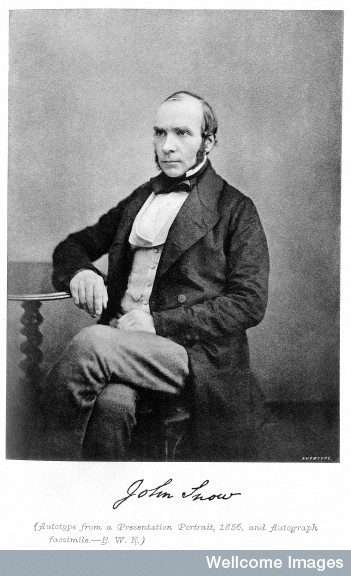
The high-profile marking of John Snow’s bicentenary on the fifteenth of March would have surprised the great man. The London School of Hygiene and Tropical Medicine, the WellcomeTrust, and The Lancet were among the august UK organisations to honour him with events including an exhibition, three days of seminars, and a gala dinner. The physician was also celebrated in the United States where he has a large fan base.
By the time of his death, on 16 June 1858 at the age of 45, Snow was convinced beyond doubt that his theory on the mode of transmission of epidemic cholera was correct but had little expectation that any credit would accrue to him. His friend, the Soho curate Henry Whitehead, said Snow predicted that he might not live to see the day when great cholera outbreaks were in the past — which was true — and also that his name would be forgotten when that day came, which was not. On the contrary, he is now widely regarded as the father of the science of epidemiology, with his life and work the subject of countless books, articles and web pages, while 200 years after his birth his legacy remains the focus of lively academic debate.
John Snow, 1856. Credit: Wellcome Library, London. Wellcome Images Copyrighted work available under Creative Commons by-nc 2.0 UK.
This article originally appeared on the OUPblog on 31 October 2012: http://blog.oup.com/2012/10/parental-height-children-health/
What can the height of a person tell us about them and their children? Although determined to an extent by genes, the height of a fully grown man or woman can be considered as a ‘marker’ of the circumstances they experienced early in life. These childhood circumstances include illness, living conditions, diet, and maybe even stress. Such early life circumstances have been shown to be linked to health risks later in life. In fact, the height of an individual is also linked with their chance of developing chronic health conditions. Taller people are at lower risk of heart disease, for example.
But what about the height of their parents? One may wonder if that could have an effect? Evidence from studies of animals indicates that poor health which is caused by challenging circumstances during development early in life may be transmitted from generation to generation. Continue reading “Parents: does size matter?”→
This article originally appeared on the OUPblog on 19 September 2013: http://blog.oup.com/2013/09/demographic-landscape-bad-news/. It is reproduced here with updated figures and captions.
In the first part of this post, I showed how we used a classic mapping technique — contour plots — to explore the demographic landscape, examining the texture of the lives and deaths of billions of people from more than forty countries. Our maps showed how a third variable, mortality rates, varied against two others: age and time. Just as the coordinates of physical terrain are latitude and longitude, so the coordinates of mortality terrain are age and year, or age-time.
Previously, we saw how these contour maps highlighted the good news we found in demographic changes. Today we explore the bad news.
Period effects: The dinosaurs of the twentieth century
Our demography has been scarred by the two World Wars. In our maps these appear as two thin clusters of ovals, like onions that have been flattened then cut open. Topographically, these oval clusters show mortality risk jutting shard-like out of the lowlands of early adulthood like the kite-shaped plates of a stegosaurus. These are period effects, disruptions to the usual order. The bathtub-shaped age-specific mortality risks for the cohorts of men who had come of age by the onset of these wars had spikes in them. Women of the same age, though protected by patriarchal gender inequality from the front line, were still exposed to much of this additional risk, especially if they had the misfortune of having one’s home located in what turned into a battlefield. Continue reading “The demographic landscape, part II: The bad news”→
This article originally appeared on the OUPblog on 18 September 2013: http://blog.oup.com/2013/09/demographic-landscape-good-news/. It is reproduced here with some updated figures and captions.
If demography were a landscape, what would it look like? Every country has a different geographical shape and texture, visible at high relief, like an extra-terrestrial fingerprint. But what about the shape and texture revealed by the demographic records of the people who live and die on these tracts of land?
Maps show the fingerprints of the physical landscape on a human scale, letting us see the forests for the trees, the regions for the forests, and the countries for the regions. They are powerful visualisation techniques, knowledge tools for comprehending enormity.
This article originally appeared on the OUPblog on 14 April 2011: http://blog.oup.com/2011/04/life-expectancy/
Making a difference to the health of populations, however small, is what most people in public health hope they are doing. Epidemiologists are no exception. But often caught up in the minutiae of our day-to-day work, it is easy to lose sight of the bigger picture. Is health improving, mortality declining, are things moving in a positive direction? Getting out and taking in the view (metaphorically as well as literally) can have a salutary effect. It broadens our perspectives and challenges our assumptions. Looking at recent trends in European life expectancy is a case in point.
Since 1950 estimated life expectancy at birth of the world’s population has been increasing. Initially, this was accompanied by a convergence in mortality experience across the globe—with gains in all regions. However, in the final 15 years of the 20th century, convergence was replaced with divergence, in part due to declines in life expectancy in sub-Saharan Africa. However, this global divergence was also the result of declining life expectancy in Europe. Home to 1 in 10 of the world’s population, and mainly comprised of industrialized, high-income countries, Europe has over 50 states. These include Sweden and Iceland that have consistently been ranked among the countries with the highest life expectancies in the world. But while for the past 60 years all Western European countries have shown increases in life expectancy, the countries of Central and Eastern Europe (CEE), Russia and other parts of the former Soviet Union have had a very different, and altogether more negative experience. Continue reading “Trends in European life expectancy: a salutary view”→