
Matthew C Lohman, Anwar T Merchant and Catherine Y Chi

The Supplemental Nutrition Assistance Program (SNAP) is an initiative that provides food benefits to low-income Americans to help them afford groceries. Claims that use of SNAP contributes to bad health outcomes appear often in research and the media. Some studies have found that people who use SNAP have worse diet quality, higher bodyweight and poorer cognitive performance than those who don’t. Such findings are sometimes used, implicitly or explicitly, to justify more restrictive eligibility rules, work requirements or other policies that could reduce access to the program.
But a closer look at the evidence suggests we should be more cautious in how we interpret it. Our recent study in the International Journal of Epidemiology found that, by using methods designed to deal with hidden bias, apparent relationships between SNAP use and negative outcomes like cognitive decline largely disappear.
The main challenge: unmeasured bias
Most SNAP research relies on observational data, meaning researchers observe program participation in the real world, rather than randomly assigning people to receive SNAP or not and then looking at the differences in outcomes between them. This introduces an analytical challenge – people who use SNAP tend to already be different than those who don’t. SNAP users typically have fewer financial resources and poorer health and are more socially disadvantaged than those who don’t use SNAP (whether they’re eligible to or not). If these differences are ignored, they can lead to the wrong conclusion that SNAP causes poorer health outcomes.
Researchers often deal with this problem by using regression analysis to balance existing differences between SNAP users and non-users in income, education, race, age, chronic conditions and other factors. However, some characteristics, like lifetime hardship, exposure to stress, health consciousness or access to care (which are correlated with poorer health outcomes), may be difficult or impossible to measure. So, even with complex statistical procedures, the effects of pre-existing differences may persist, leading researchers to confuse the effects of SNAP with the circumstances that lead people to use SNAP in the first place.
A clever workaround: negative controls
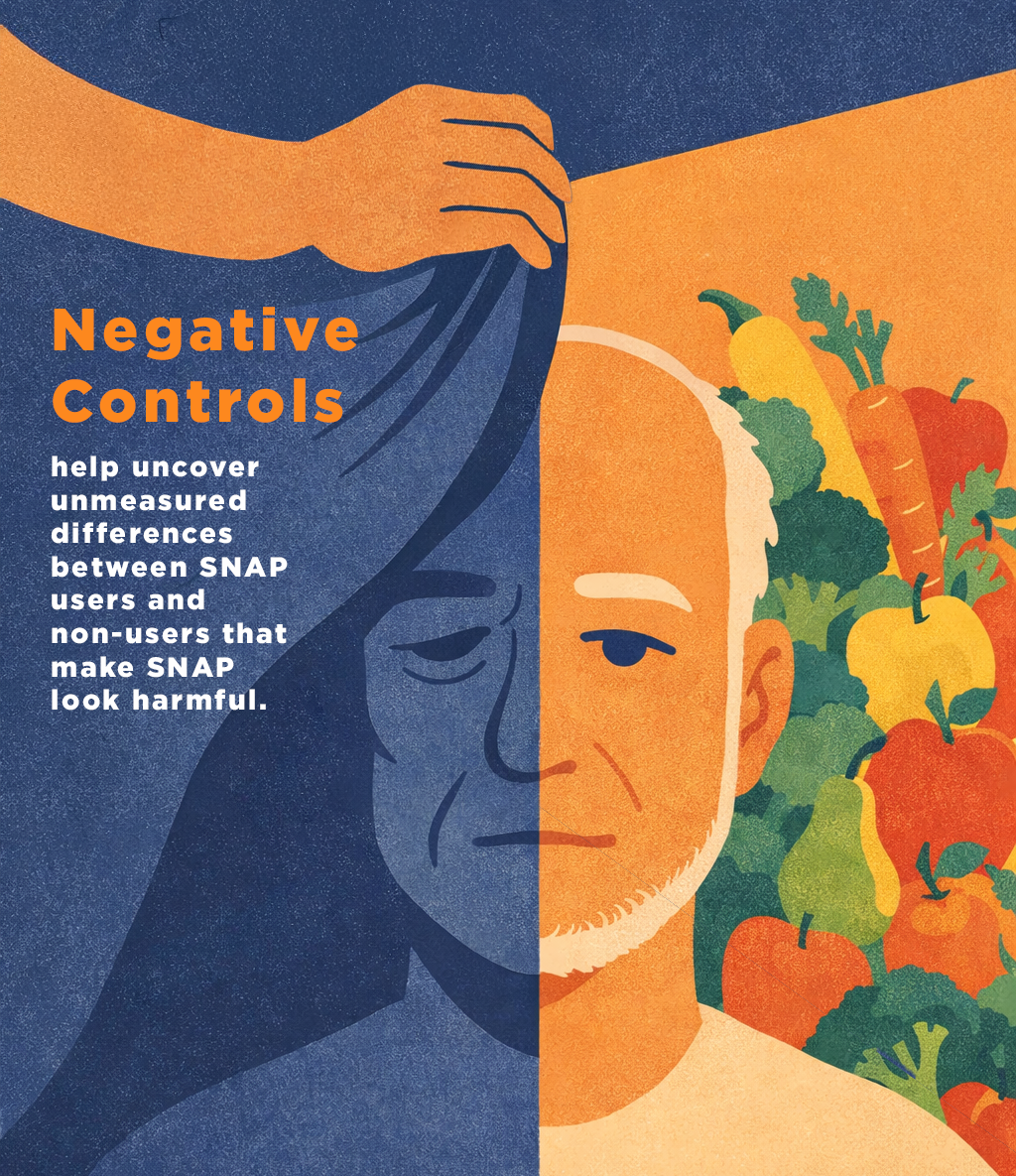
In our study, we looked at SNAP use and cognitive performance among nearly 12,000 older adults participating in the Health and Retirement Study from 2008 to 2018. Instead of relying on traditional regression analysis alone, we used negative control adjustment to help deal with unmeasured bias. The idea behind this approach is simple:
- evaluate associations between SNAP and outcomes it could not possibly cause
- use any “impossible” associations as indicators of hidden bias and adjust for it.
For example: using SNAP in 2008 obviously can’t affect someone’s cognition in 2006. So if there is an association between these two things, it must be because of other non-causal reasons (bias).
What happens when we use negative controls?
Using standard regression, we found that SNAP users seemed to score consistently worse on cognitive tests for up to a decade after using SNAP – an alarming result.
However, once we applied negative controls, these associations mostly disappeared. Across multiple survey waves, SNAP use showed little to no effect, either positive or negative, on cognitive performance.
The same pattern appeared when we analysed a different outcome altogether – body mass index (BMI).
This doesn’t imply that SNAP improves cognition, but that the earlier claims that it causes harm are likely driven by pre-existing differences between participants and non-participants, not by the program itself.
Why this matters
This isn’t just a technical debate for epidemiologists. Older adults have the lowest SNAP participation rate of eligible people in any age group – only about 42%. Many avoid the program because of stigma, misinformation or fears that using it signals dependency. Recent policy changes around eligibility and work requirements could further reduce access to the program.
Yet older adults may benefit substantially from using SNAP. Compared with their peers, older SNAP users take prescription medications more regularly, control their diabetes and high blood pressure better, and have less depression and fewer hospital costs. If research incorrectly paints SNAP as harmful, that misinformation can shape public opinion, personal decisions and policy choices. Negative control methods are not a silver bullet, but they offer a simple way to stress-test causal claims, when misinterpretations can have real-world consequences.
SNAP doesn’t appear to damage cognitive health. What it does do is support people who are already facing serious disadvantages. When we fail to account for that, we risk blaming the safety net instead of recognising the depth of need to which it’s responding.
Read more:
Lohman MC, Mishio Bawa E, Wei J, Merchant AT. Supplemental Nutrition Assistance Program use and cognitive performance in middle-aged and older adults. Int J Epidemiol 2026; 55: dyag021. doi: 10.1093/ije/dyag021.
Matthew C. Lohman is an Associate Professor in the Department of Epidemiology and Biostatistics, Arnold School of Public Health, University of South Carolina, USA.
Anwar T. Merchant is a Professor in the Department of Epidemiology and Biostatistics, Arnold School of Public Health, University of South Carolina, USA.
Catherine Y. Chi is a Senior Instructor in Media Arts/Studio Art, McCausland College of Arts and Sciences, University of South Carolina, USA.
 IJEblog